
If you told us many years ago that the handheld market would someday include hardware from Nintendo and Microsoft’s Xbox brand, we’d probably have called you silly for even suggesting such a possibility. That being said though, the portable gaming scene has now evolved with more brands competing for the top spot, and Xbox has finally joined the party as well.
CHECK OUT: Xiaomi Wants to Take on Flagship Smartphone Rivals with its New 15T Series
For those who are unaware, Microsoft teamed up with hardware manufacturer ASUS to develop and launch the “Xbox Ally” series handhelds, which were partly based on ASUS own ROG-branded devices. As such, they’re now finally available for pre-order via Microsoft and participating retailers in the United Kingdom, with prices starting at £499 for the ROG Xbox Ally with 16GB RAM and 512GB storage, and £799 for the ROG Xbox Ally X with 24GB RAM and 1TB of storage. Additionally, the upcoming handhelds will launch on October 16, 2025, with availability in the United States, Europe, Asia, the Middle East, with more regions to come later.

Both models look practically the same thanks to their overall shape and 7-inch screens, both of which support 120Hz refresh rates. Other hardware features include impulse triggers with support for haptic feedback, USB-C 4 connectivity with Thunderbolt 4 support, a USB-C 3.2 port and a UHS-II microSD card reader, although it should be noted that the standard Xbox Ally comes with dual USB-C 3.2 ports.
As for other differences between the two models, the ROG Xbox Ally comes with more modest specs (as you can probably tell from the lack of an extra ‘X’) when compared to the Xbox Ally X, the latter of which comes with a sharper 1080p resolution display. Under the hood, the Xbox Ally is powered by an AMD Ryzen Z2 A processor along with 16GB LPDDR5X-6400 RAM and 512GB of internal storage. On the other hand, the more expensive Ally X features a more powerful AMD Ryzen AI Z2 Extreme chip, in addition to 24GB of LPDDR5X-8000 RAM and 1TB of storage.
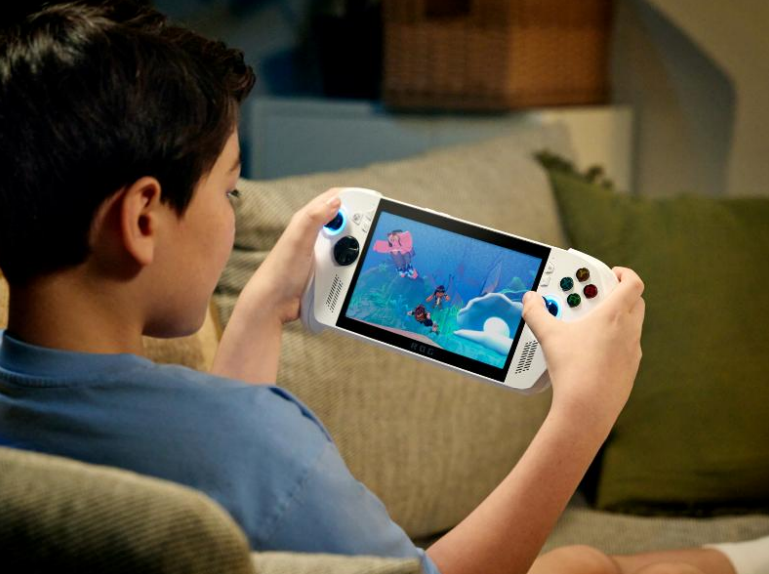
Both models feature a software menu that manages to mash up Windows and the Xbox series’ UI, which results in a somewhat shrunken-down version of the Xbox interface. Windows will run in the backend, and users can directly access the Xbox PC app which will allow them to view their games library from Microsoft, Battle.net, Steam, and more. There’s also support for gaming via cloud platforms, which is a much-welcome feature to have.
CHECK OUT: Qualcomm Hits Back at MediaTek with the New Snapdragon 8 Elite Gen 5
With all that in mind, the Xbox Ally series does have quite a roster of formidable rivals, such as Nintendo’s Switch 2 hybrid console, the new Lenovo Legion Go 2, and even more niche options from brands like AYANEO, for example. On the other hand though, the Ally handhelds manage to stand out thanks to direct integration with Microsoft’s Xbox brand and library, buy only time will tell if they manage to stand their ground in an already crowded market.